
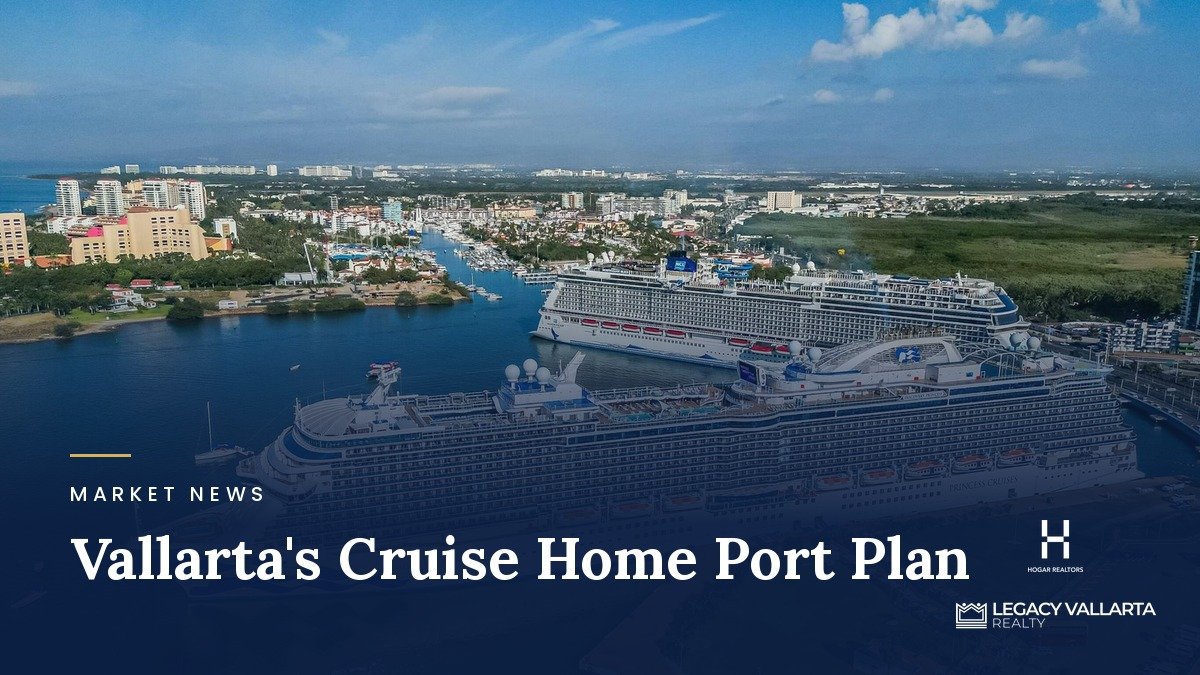
Puerto Vallarta is already a regular stop for cruise ships, and there has been talk of a larger role as a home port. If you own here or plan to, it is worth understanding what that term means and what to watch for.
This is a plain-language explainer, not a prediction.
This article is general information for planning purposes and is not legal, tax, medical or financial advice. Rules and conditions change, so confirm details with the official sources and licensed professionals named below before you act.
Port of call versus home port
A port of call is a stop on an itinerary: passengers visit for a day and return to the ship. A home port is where a cruise begins and ends, which means passengers arrive and depart through the city, often staying in hotels before or after. That is a different kind of demand for airlines, hotels, transport and services.
What was announced in September 2026
In mid-September 2026, Jalisco Governor Pablo Lemus said the federal government had chosen Puerto Vallarta for what would be Mexico’s first cruise home port, and that construction was expected to begin next year. A week later, on September 22, the federal Tourism and Navy secretaries presented more detail. According to that coverage, the project would be built by the Secretaría de Marina through ASIPONA Puerto Vallarta, the local port authority, and would cover about 95,000 square meters, roughly 38,000 of land and 57,000 of water, with three cruise piers plus areas for passenger boarding, port services, and commercial and entertainment uses.
It is also listed as a priority project in the port’s Master Development Program for 2026-2031. For context, the same coverage reported that Mexican ports received about 7.5 million cruise passengers from January to July 2026, an increase of around 16 percent over the same period of 2025.
What the coverage did not include is just as useful to know: an investment amount, a completion date, and the number of ships or passengers the terminal would handle. So today this is an announced federal project with a described scope, not a finished timeline.
What would need to be true
A home port role depends on port facilities, airport capacity and connections, customs and immigration processes, and agreements with cruise lines. Announcements and studies come first; funding and construction come later. Follow the port authority rather than rumors.
Possible effects, good and mixed
More activity could support hotels, restaurants and jobs. It could also mean more traffic and crowding near the waterfront and the Malecón. As an owner or buyer, think about how a specific street or building would feel on busy days, not only about averages. See noise in Puerto Vallarta and infrastructure in Banderas Bay.
What to watch next
Instead of trying to guess the effect, watch for a few concrete signals. Official publication of the budget and the construction contract. A start date for work and a phased calendar. Statements from airlines about added capacity at the airport, since home port passengers arrive and leave by air. And any plan for how traffic will move between the terminal, the airport and the hotel zone, because that is what residents would feel day to day.
Who might notice it, and who probably will not
If you live or own near the cruise terminal, the Marina area or the main roads between the airport and downtown, you are the most likely to notice changes in traffic, noise and demand for short stays. If you live in neighborhoods farther from those corridors, the effect may be small and indirect. Either way, a port project is a reason to look at the specific street and building you are considering, not a reason to assume a whole area will rise in value.
For owners who rent short term, more visitors who arrive before or after a cruise could mean more demand for one or two nights, but that is a possibility, not a promise. If you are comparing buildings, ask about the short-term rental rules in the condominium regulations. Rules for short-term rentals in Jalisco have been under discussion, so confirm the current status before you count on that income.
What this means for property
Do not buy because of one announcement. Judge a property on its location, condition, legal status and costs. Our first-time buyer mistakes article covers the basics that matter more than any headline.
Related reading
- Puerto Vallarta market update, September 2026
- Neighborhoods by return
- Condo vs. house in Puerto Vallarta
- Pre-purchase inspection
Where to find more information
Port plans and statistics: ASIPONA Puerto Vallarta (the port administration) and the Secretaría de Turismo of Jalisco. Airport and connectivity: the airport operator and federal transport authorities. Local market perspective: AMPI Vallarta y Compostela.
Questions about buying or living in Puerto Vallarta? Book a call with me, message me on WhatsApp, or keep reading on the Legacy Vallarta Realty blog.
Legacy Vallarta Realty shares local market perspective for information only. Nothing here is a guarantee of future prices, rental income or timelines.




Join The Discussion