
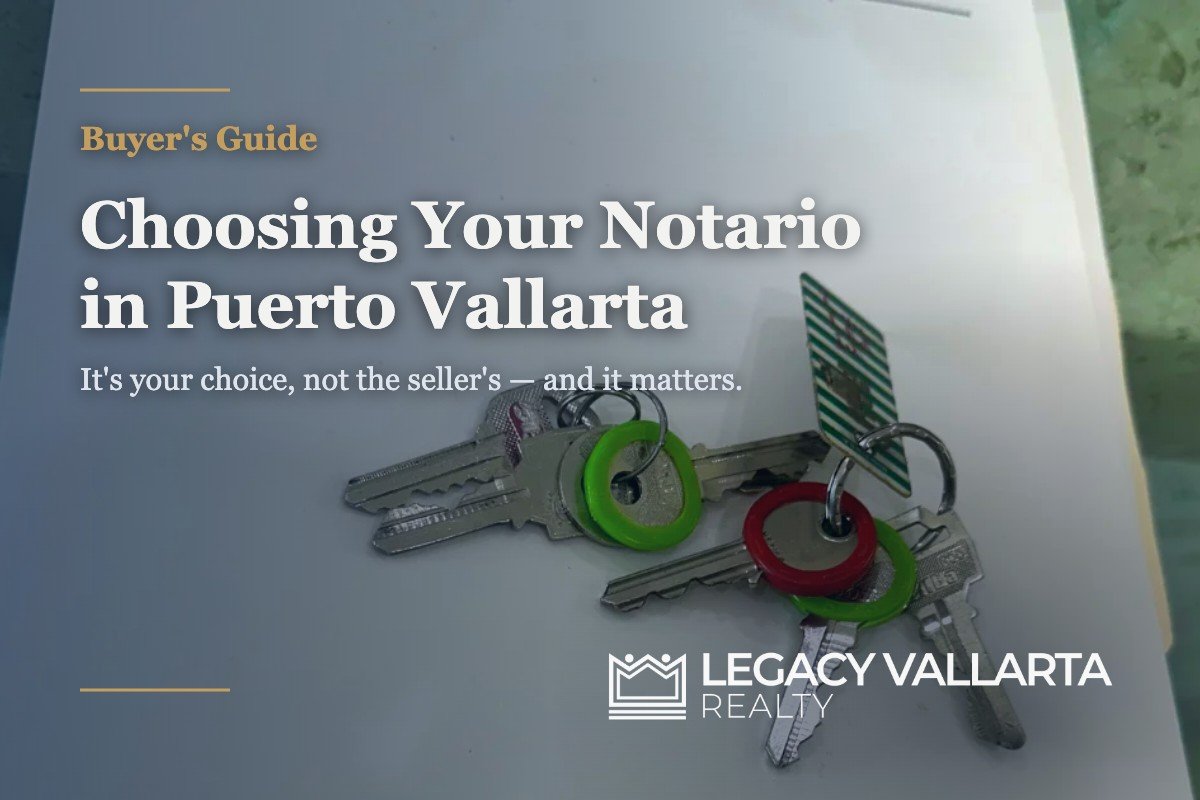
There is a word in Mexican real estate that looks exactly like an English word and means something entirely different, and that mistranslation costs foreign buyers real money.
Notario.
An American notary public is a clerk. Their training takes an afternoon. They watch you sign, they stamp the page, and their role in your transaction is essentially clerical.
A Mexican notario público is a licensed attorney, appointed by the state governor, holding one of a strictly limited number of patentes in the state. Jalisco has a fixed number and they rarely come open. The notario carries fe pública — the legal authority to attest that a transaction is valid and true.
Their signature is what makes your property transfer real. Nothing else does. Not your contract. Not your wire transfer. Not the keys in your hand.
Understanding this changes how you approach the purchase.
What the notario actually does
Once engaged, the notario runs the legal verification of your transaction:
*Certificate of no liens (certificado de libertad de gravamen).* Pulled from the Public Registry of Property. Shows whether the property carries a mortgage, an embargo, a lawsuit annotation, or any other encumbrance — and confirms the seller is in fact the registered owner. That last point is not something to assume from a photocopy of a deed.
*Property tax clearance (predial al corriente). Municipal certificate confirming taxes are paid current. Unpaid predial follows the property, not the person.* If you close without this, you inherit the debt.
Water clearance (SEAPAL). Same principle, same consequence.
HOA clearance. Confirmation that maintenance fees are current — plus, and this is the one buyers forget to ask for, disclosure of any special assessment that has been voted or is under discussion. A building about to assess owners $8,000 each for elevators is not going to volunteer that during your showing.
*Appraisal (avalúo).* A licensed appraiser produces the valuation your acquisition tax is calculated on.
Tax calculation and withholding. The notario calculates the seller’s capital gains tax, withholds it, and remits it to SAT.
*Preparation and recording of the escritura pública*** — the deed itself.
The fideicomiso and SRE permit. If you are buying in the restricted coastal zone, the bank trust and the permit from the Secretaría de Relaciones Exteriores are being processed in parallel. See the fideicomiso explained. In the timeline, this is usually the longest pole in the tent.
Three things you need to internalize
One: the notario is not your lawyer
This is the most important sentence in this article.
The notario is a neutral state functionary. They verify title, verify tax status, calculate and withhold taxes, and record the deed. They do not advocate for you. They are not reviewing the transaction for whether it is a good deal, whether the price is fair, or whether the contract terms favor the other side.
If you want an advocate, you hire a private attorney separately. For a straightforward condo purchase with clean title, most buyers do not. For a complicated purchase — ejido land history, an unconstituted condominium regime, an estate sale, a contested title — you should, and it is not expensive relative to what it protects.
There is a second role worth knowing about, and it is neither the notario nor your agent. In my own transactions I work with Cecilia Medina, an attorney who acts as closing coordinator — her job is to keep the file moving and to make sure every party actually understands what they are signing, in language they follow. On a straightforward condo purchase you may not need one. On anything with a complication, it is often the difference between a closing that takes eight weeks and one that takes five months.
Two: whoever chooses the notario controls the transaction’s pace and quality
In Puerto Vallarta, custom gives the buyer the right to choose the notario, because the buyer pays for it. Closing costs of roughly 4–6% of the purchase price include this — I break the full list down in what it really costs to buy.
Use that right. Notary offices in Puerto Vallarta vary enormously in how fast they move and how carefully they review. Some are meticulous and slow. Some are fast and thorough. Some are neither.
If the seller or the seller’s agent pushes hard for a specific notaría, that is not automatically sinister — sometimes their notario already holds the property’s history and it genuinely speeds things up. But it is worth one direct question: why that one? A good answer exists or it doesn’t.
That question applies to me too, so here is my own answer. I work most often with Notaría 29 in Bucerías and Notaría 1 in Puerto Vallarta. The reason is short: both are fast, both are organized, and I have never had to chase either of them for a document. That is the entire recommendation. If your agent cannot give you a reason that specific in one sentence, do not take it — convenience for the agent is not a reason.
And one correction to advice you will see repeated in guides written for foreign buyers: English-speaking staff is not a differentiator in Puerto Vallarta. Effectively every notaría here works in English, because effectively every notaría here handles foreign purchases. Do not choose one on that basis. Choose on turnaround, and on how organized the office is with documents.
The broader dynamic here is one I wrote about in why the same request gets different results: Mexican institutions run on federal rules plus significant local discretion. The same file moves at very different speeds through different offices. Which notaría you pick is one of the few levers you actually control.
Three: until the escritura is signed, you own nothing
No matter what you have paid, no matter what you have signed, no matter who handed you keys. The deed is prepared by the notario and signed at their office, and that signature is the moment ownership transfers.
This is exactly why you never wire money directly to a seller — a point I make at length in escrow in Puerto Vallarta, and the single most important rule in a Mexican transaction.
What to ask before choosing
Ask your agent: “Which notaría would you use for your own purchase, and why?” The answer, and how quickly it comes, tells you a great deal.
Then ask the notaría directly:
- What is your current turnaround from engagement to closing on a foreign purchase with a new fideicomiso?
- Do you have staff who work in English? Ask, but do not weight it heavily — in Puerto Vallarta the answer is almost always yes. What actually varies between offices is how organized they are with documents.
- What do you need from me, and when? A good notaría gives you a document list on day one. If they cannot, expect surprises in week six.
- Have you worked with this bank on fideicomisos before? Familiarity with the specific trust bank meaningfully affects timing.
- What is your fee, itemized?
At the signing: check these personally
When the deed is prepared, you review it before signing — in Spanish, with your agent or attorney translating. If any detail is wrong, this is the moment to stop, because after signature it becomes an expensive correction.
Verify with your own eyes:
- Your name spelled exactly as it appears on your passport. Exactly.
- The property description and area.
- Parking space and storage unit assignments. Parking in Puerto Vallarta is frequently titled separately from the unit, and buyers assume the space they were shown comes with the condo. Read the deed and confirm the cajón is included by number.
- The beneficiaries named in your fideicomiso. This is your estate planning. Get it right now.
- The sale price recorded.
That last one deserves its own warning.
Never under-declare the price
Some sellers will ask you to record a price lower than the true one, to reduce their capital gains tax.
Refuse. Every time.
It is tax fraud, it exposes you personally, and — set aside the legal exposure for a moment — it inflates your own capital gains when you eventually sell, because your cost basis is whatever the deed says. You would be paying the seller’s tax bill for them, years later, with interest. The arithmetic behind that is in capital gains tax when you sell.
The request is usually framed as a small favor that everyone does. It is not a favor. It is a transfer of the seller’s tax liability onto you, disguised as a courtesy.
The practical summary
- The notario is a state-appointed attorney whose signature creates your ownership
- They are neutral — not your advocate
- You choose them, because you pay for them
- Ask your agent to justify their recommendation with a reason
- Hire a private attorney separately if the purchase is complicated
- Review the deed carefully before signing; corrections after are expensive
- Never under-declare the sale price
None of this is exotic. It is the same discipline you would bring to a purchase at home. The difference is only that here, the protections sit at different points along the timeline — and now you know where they are.
Message me on WhatsApp and I will walk you through which notaría fits your purchase and why.
Choosing your own notario is mistake five on the list of ten mistakes first-time foreign buyers make here. The other nine are worth reading before you make an offer.
— Neft Román, Legacy Vallarta Realty
Affiliate of AMPI Puerto Vallarta y Compostela
This is general information about how notarial practice works in Jalisco, written for buyers — not legal advice. Closing-cost percentages, notarial fees, turnaround times and documentary criteria vary by office, by transaction and over time. The notarías named here are my own working preferences based on my experience with them, not an endorsement or a guarantee of anyone else’s result. Confirm the specifics with the notaría handling your purchase.
📐 Full written guide: legacyvallartarealty.com
📅 Book a 30-minute call: meetings.hubspot.com/neft
💬 Or message me on WhatsApp: wa.me/523227797718
🏠 More guides on living in Puerto Vallarta: legacyvallartarealty.com/blog
Legacy Vallarta Realty — Puerto Vallarta, Jalisco.
— Neft Román, Legacy Vallarta Realty
Affiliate of AMPI Puerto Vallarta y Compostela


Join The Discussion