
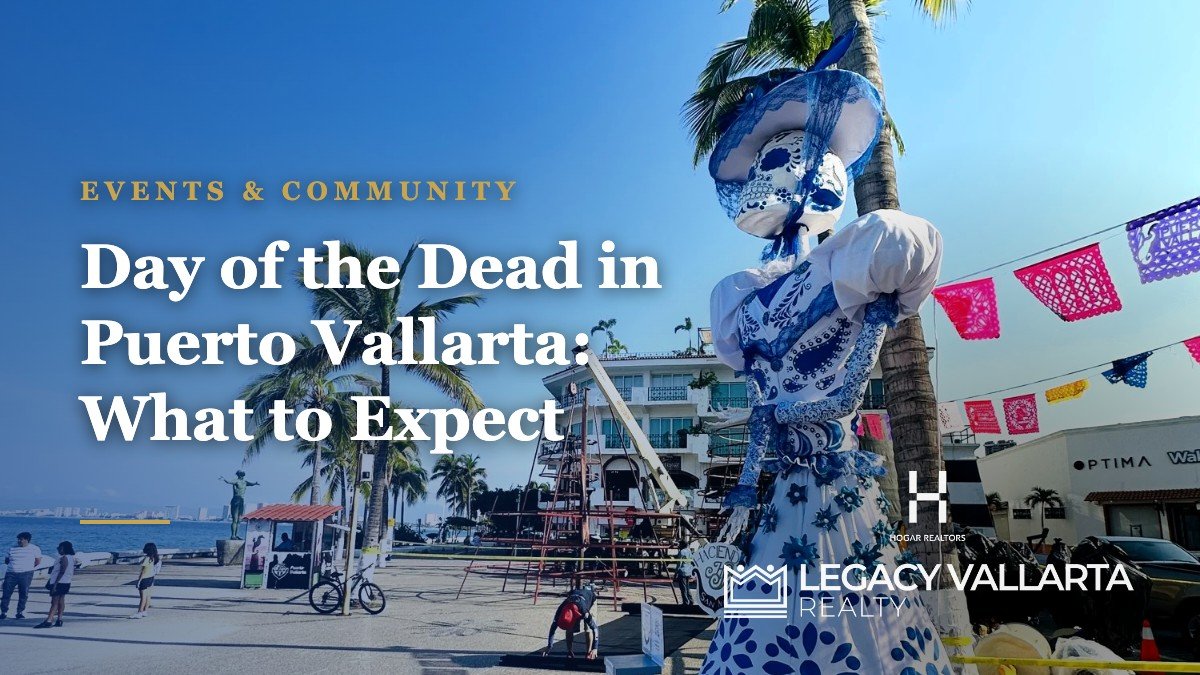
Día de Muertos, the Day of the Dead, is one of Mexico’s most meaningful traditions, and Puerto Vallarta marks it with altars, family gatherings and public events. If you are visiting or living here, this guide explains what the holiday is and how to take part respectfully.
This article is general information for planning purposes and is not legal, tax, medical or financial advice. Rules and conditions change, so confirm details with the official sources and licensed professionals named below before you act.
What the holiday is
Día de Muertos is a time to remember loved ones who have died. It is traditionally observed on November 1 and 2, and families build altars called ofrendas with photos, candles, flowers, favorite foods and drinks. It is a celebration of memory, not a Mexican version of Halloween.
Where the tradition comes from
Día de Muertos grew out of Indigenous practices of honoring the dead that blended, over centuries, with the Catholic calendar of All Saints’ Day (November 1) and All Souls’ Day (November 2). In 2008 UNESCO inscribed Mexico’s Indigenous festivity dedicated to the dead on its Representative List of the Intangible Cultural Heritage of Humanity, which gives a sense of how seriously the tradition is taken nationally.
In many families the first night is for children who have died, often called angelitos, and the second for adults, though the details vary by region and by household. What stays constant is the idea that the dead come back to visit and that the living prepare the table for them. That is why the mood is warm and often cheerful rather than somber.
What goes on an ofrenda, and what it means
If you are invited to a home altar, or you stop at a public one, it helps to know what you are looking at. The elements below are common, though every family builds its own and no two altars are identical.
- A photo of the person being remembered. The altar is built around them, so this is the center of the display.
- Cempasúchil (marigolds). The bright orange flowers and their scent are traditionally said to guide the spirits back.
- Candles and copal incense. Light and smoke mark the path and the welcome.
- Water and salt. Often placed so the visitor can refresh after the journey.
- Favorite food and drink. Pan de muerto, fruit, tamales, a cup of coffee or a bottle of something the person enjoyed.
- Papel picado and sugar skulls. The cut-paper banners and decorated skulls are the festive part, and the skulls often carry a name.
Please do not take food or flowers from an altar, even a public one. Everything on it is an offering.
What you will see around town
Expect altars in homes, businesses, schools and public squares, marigold flowers (cempasúchil), sugar skulls, pan de muerto and Catrina figures. Many communities hold events, and the city and local organizations often schedule parades, concerts and exhibits around the dates. Programs and dates change every year, so confirm them with the official sources below. For 2026, see our post on the Festival de las Almas on the Malecón, which runs October 24 to November 15.
How to join in respectfully
Ask before photographing people at private altars or in cemeteries, keep your voice down, and do not touch offerings. If you are invited to a family altar, it is an honor, so bring flowers or a small contribution. Dress up as a Catrina if you like, but treat the tradition with care.
The 2026 program, and how earlier years were laid out
For 2026, Puerto Vallarta is one of the Jalisco municipalities taking part in the Festival de las Almas, the state’s Day of the Dead program, which runs from October 24 to November 15. According to press coverage of the state announcement, this is the festival’s second edition, with more than 350 free activities across eleven municipalities. I cover the Puerto Vallarta installations on the Malecón in our Festival de las Almas post, so I will not repeat them here.
Programs are announced close to the dates and do change, so treat what follows as a picture of how past editions have worked, not a schedule. Local press for the 2022 season, for example, described a giant Catrina lit on the Malecón, performances and a living-Catrina contest at Los Arcos, a community afternoon on Isla Cuale on November 2 with face painting, ofrendas and storytelling in English and Spanish, and altar and costume contests in neighborhoods such as Ixtapa and Las Palmas. If that pattern holds, the evenings around the waterfront are the busy ones, and the neighborhood events are the more local, family-scale ones.
Visiting a cemetery: a few practical rules
Many families spend part of November 1 or 2 at the grave of a relative, cleaning it, bringing flowers and sometimes music and food. In Puerto Vallarta, the Cementerio Cinco de Diciembre is one place where this happens. A cemetery on these days is a family space first and a sight second. Here is what I would follow:
- Go with the intention to observe quietly. If you are unsure whether visitors are welcome in a particular section, ask.
- Stay on the paths and near the edges. Do not stand or sit on headstones, and do not step on or between graves.
- Ask before photographing a person, and avoid photographing mourners who have not agreed. A wide shot of decorated graves is different from a close-up of a family.
- Do not touch or move offerings, and keep your voice and any music low.
- If a family offers you pan de muerto or invites you to join, accept graciously. It is meant as hospitality.
Practical tips for visiting during the festival weeks
Late October and early November is also a busy visiting period, so a little planning goes a long way. These are general suggestions, not guarantees about any particular day.
- Evenings are busier than mornings. If you want a quieter look at the Malecón installations, go earlier and walk back before the crowds build.
- Parking and rides. Streets near the waterfront can fill up. Walking, or a taxi or ride from a few blocks away, is usually easier than looking for a space.
- Dress for the weather. It is still warm and humid in the evenings, and rain may linger into October. Bring water and a light layer.
- Confirm hours. Restaurants, shops and offices may change their hours around the holiday. Check before you plan around a specific opening time.
- Keep valuables secure. As at any crowded event, carry only what you need.
If you are staying in a rental near the center, expect more foot traffic and some noise in the evenings. That is part of the season, and it is worth asking the host or manager what to expect when you book.
If you live here or are thinking of moving
Holidays like this are a big part of settling in. Our guides on Spanish classes and neighborhoods can help you find where you want to experience them, and note that streets near events can be noisy and crowded; see noise in Puerto Vallarta.
Related reading
- Spanish classes
- Rent a month before you buy
- Neighborhoods by return
- Free home exercise guide for adults 65+
Where to find more information
Event dates and programs: the Puerto Vallarta municipal government, the Secretaría de Turismo of Jalisco and the Puerto Vallarta tourism board. Local community listings: neighborhood and expat community groups.
Questions about buying or living in Puerto Vallarta? Book a call with me, message me on WhatsApp, or keep reading on the Legacy Vallarta Realty blog.
Legacy Vallarta Realty shares local market perspective for information only. Nothing here is a guarantee of future prices, rental income or timelines.

Join The Discussion