
By Neft Román — Legacy Vallarta Realty
Every few months a buyer asks me some version of the same question: I drive an electric car, can I actually live in Puerto Vallarta with it? The honest answer is yes, and it is easier than it was two years ago, but the infrastructure here does not look like the infrastructure in California or Vancouver. You do not casually pull into a fast charger on your way home. You charge at home overnight, and you treat public charging as a backup rather than a habit.
That is not a complaint. It is just a different mental model, and once you understand it the whole thing stops being stressful. Here is what actually exists in the bay, what it costs, and what to check before you buy a condo with an EV in the garage.
What public charging actually exists in the bay
The number that matters is small, and I would rather give you the small true number than a vague reassurance. Public charging in Puerto Vallarta is measured in a handful of locations, not dozens.
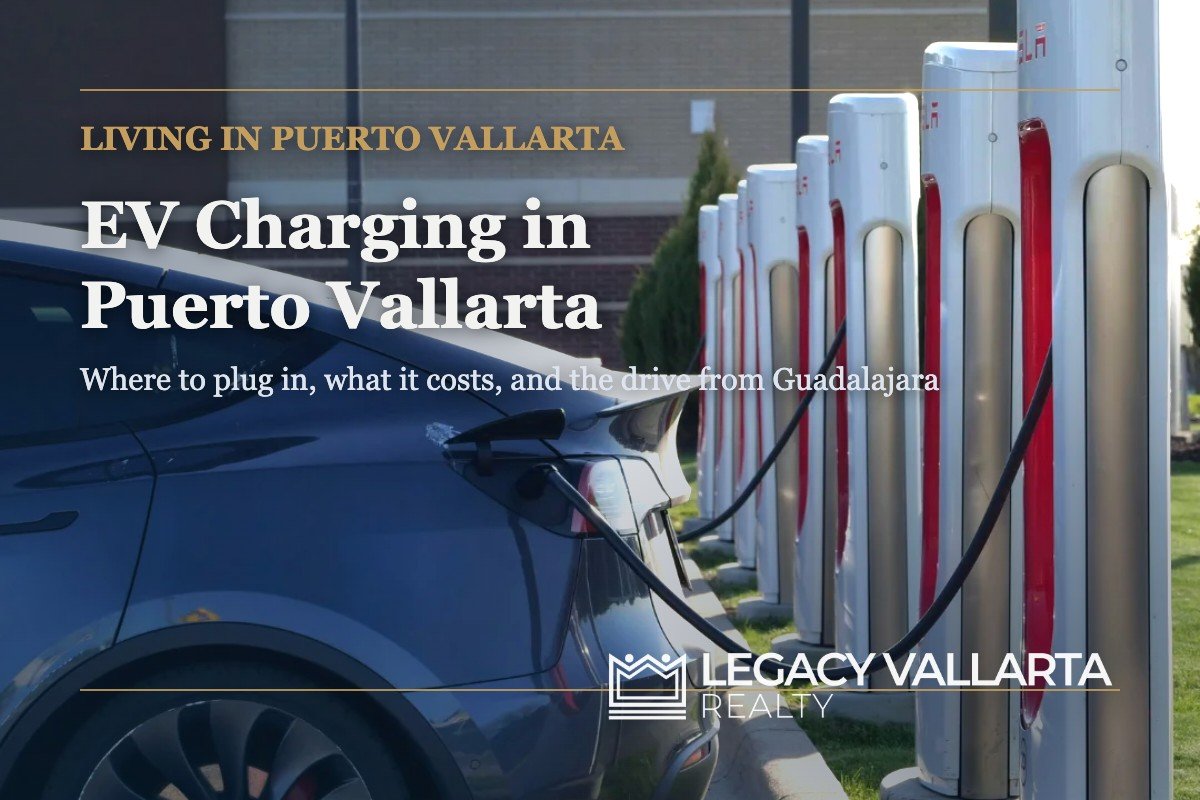
- A Tesla Supercharger at Plaza Península on Av. Francisco Medina Ascencio in the Zona Hotelera — four stalls, up to 250 kW, open 24 hours. This is the only genuinely fast charging in the city, and it is the one that makes EV ownership here practical.
- A Tesla destination charger at The Westin Resort & Spa in Marina Vallarta — two units at up to 16 kW, for guests and customers.
- Aerotron Vallarta, in the private terminal parking at the airport — three units at up to 18 kW, including a J1772 connector that works with non-Tesla cars.
Beyond that you are looking at a thin scattering of slower units at hotels and a few businesses, and the listings change. Do not plan around a charger you read about once. Check PlugShare or Electromaps the day you need it — both cover Mexico properly and both show whether a unit is actually working, which is the part a static map never tells you.
One thing worth knowing, because it tells you where the state is heading: in July 2026 Puerto Vallarta launched Jalisco’s first electromobility system outside the Guadalajara metro area, with nineteen electric buses and ten charging stations built for the fleet, anchored by a charging terminal in Las Juntas. Those chargers are for the buses, not for you. But a municipality that has just wired itself for a bus fleet is a municipality where public charging gets easier, not harder.
What it costs, and why home charging is the real answer
Public charging in Mexico in 2026 runs roughly 7.50 to 9.00 pesos per kWh, which puts a full charge somewhere around 300 to 360 pesos depending on the car. That is cheap against gasoline, but it is not the cheap number.
The cheap number is at home. On a standard CFE residential tariff you are looking at somewhere between 1.60 and 5.20 pesos per kWh depending on how much total electricity your household burns in a month — and that dependency is the whole story. CFE bills in tiers. Add a car to a house that already runs air conditioning through a Vallarta summer and you can push yourself into the DAC tariff, where the subsidy disappears and every kilowatt in the house gets more expensive, not just the ones you put in the car.
So the real question is not “what does charging cost.” It is “what does my whole electricity bill look like after I add a car.” Ask that one before you buy, and read our piece on how utilities work here so the tier system does not surprise you in August.
Installing a charger in a condo is a condominium question, not an electrical one
This is where I see people get stuck, and it catches them late — usually after they have already closed. Installing a wall charger in a house you own outright is a straightforward job for a licensed electrician. Installing one in a condominium is a governance question first and a wiring question second.
Your parking space is almost always common property that you have the right to use, not private property you own. Running a new circuit to it, and drawing more load off the building, generally requires approval from the asamblea — and depending on the building age, an upgrade to the electrical infrastructure that the building, not you, may end up paying for through a cuota extraordinaria.
- Ask for the reglamento interno before you make an offer and check whether it says anything about EV charging. Newer buildings increasingly do.
- Ask the administrator whether any owner has already installed one. If someone has, the path exists and you are following it. If nobody has, you are the test case.
- Ask what the building’s electrical capacity actually is. A 1990s tower in Zona Romántica and a 2024 tower in Versalles are not the same conversation.
- Expect to pay for a submeter so the building can bill your consumption to you rather than to the common account. This is normal and reasonable — do not fight it.
If that sounds like a lot, it is the same machinery we described in how condo fees and HOAs actually work here. Nothing about it is hostile. It is just slower than plugging in a toaster, and the time to find out is before you sign, not after.
Verified administrators like Administradora San Pablo and BIDA Conservadora can usually tell you a building’s capacity in one phone call. That call is free. Rewiring a garage is not.
The Guadalajara drive, and the verificación bonus
The Guadalajara run is about 350 kilometres and it climbs out of the coast into the Sierra, which eats range faster than flat highway. Most current EVs will not do it comfortably on one charge with mountain grades and air conditioning running. The good news is you do not have to: there is a Tesla Supercharger in Compostela, Nayarit, on the Vallarta–Tepic highway at a Pemex station — four stalls up to 150 kW, open 24 hours — and Guadalajara itself has destination charging at several hotels and towers. Plan one stop, not zero, and the drive is unremarkable.
For non-Tesla drivers this is the honest constraint: the fast network in this corridor is largely Tesla’s. An adapter and a Supercharger that supports other brands solves some of it, but check compatibility for your specific car before you assume the route works. I would rather you found out at your kitchen table than at a Pemex in Compostela.
One genuine advantage nobody mentions: fully electric vehicles and hybrids with full electric autonomy are exempt from verificación in Jalisco. Verificación is mandatory in Puerto Vallarta, and while it is free in 2026 when you pay your refrendo, it is still a morning of your life at the centre on Francisco Medina Ascencio. EV owners skip it. You still pay the refrendo — 1,000 pesos for a car in 2026 — but the emissions test is not your problem.
Where to Go From Here
If you are still working out the vehicle side of moving here, start with buying a car in Mexico as an expat — registration, plates and refrendo all work the same whether the car burns gasoline or not. And if you are shopping for a condo with a charger in mind, how condo fees and HOAs actually work will tell you which questions to ask the administrator before you make an offer.
If you want me to ask a specific building about its electrical capacity and EV policy before you commit to it, that is a normal part of what I do. Send me the address.
This article is for general information only and is not legal or technical advice. Charging locations, tariffs and condominium rules change; confirm current charger availability with PlugShare or Electromaps, current tariffs with CFE, and installation rules with your building administrator before purchasing a vehicle or a property.
📐 Full written guide: legacyvallartarealty.com
📅 Book a 30-minute call: meetings.hubspot.com/neft
💬 Or message me on WhatsApp: wa.me/523227797718
🏠 More guides on living in Puerto Vallarta: legacyvallartarealty.com/blog
Legacy Vallarta Realty — Puerto Vallarta, Jalisco.
— Neft Román, Legacy Vallarta Realty
Affiliate of AMPI Puerto Vallarta y Compostela



Join The Discussion