
By Neft Román — Legacy Vallarta Realty
When people ask me why two households in the same colonia, in the same size of apartment, can live on budgets that differ by six or seven hundred dollars a month, the answer is usually not rent. It is where they buy their food. The supermarket and the mercado are two different economies operating four blocks apart, and most newcomers only ever find one of them.
This is not a lecture about saving money. Shopping at the mercado is genuinely more work, and some weeks you will not want to. But it is also the part of living here that turns a neighbourhood into your neighbourhood, and that is worth more than the pesos.
Mercado, tianguis, supermercado — three different things
A mercado municipal is a permanent building with fixed stalls. It is there every day, the vendors are the same people year after year, and they are running a business with a lease.
A tianguis is a street market that appears on a given day and is gone by afternoon. Vendors set up under tarps on a closed street, sell, and pack out. The word is old — it comes from the Nahuatl tianquiztli — and the institution is older than any supermarket chain in this country by several centuries.
The one that is easiest to find is the Mercado Municipal Emiliano Zapata on Lázaro Cárdenas in the Zona Romántica. It runs daily, roughly 6:00 a.m. to 3:00 p.m., and it has produce, meat, seafood and prepared food under one roof. If you only ever learn one, learn this one.
There is also the Tianguis del Ceviche y Aguachile, which takes over Andador Francisca Rodríguez every Tuesday from about noon to 6:00 p.m. It is a specialist food market rather than a produce run, and it is one of the better afternoons in the city.
And in season — roughly November through May, closing around the start of the rains — the Old Town Farmers Market runs Saturdays from about 9:30 a.m. to 2:00 p.m. in the Zona Romántica. Note the seasonality. Almost every farmers market in Vallarta shuts for the summer, which surprises people who arrive in June expecting the market they read about in a January blog post.
The colonia tianguis — the ones in Pitillal, Ixtapa and the neighbourhoods further out — rotate by day and shift more than any published list keeps up with. I am not going to print a schedule that will be wrong by the time you read it. Ask three neighbours or the person who sells you bread. That is how everyone here knows, and asking is not an imposition; it is the normal way information moves in this city.
How to buy when nothing has a price tag
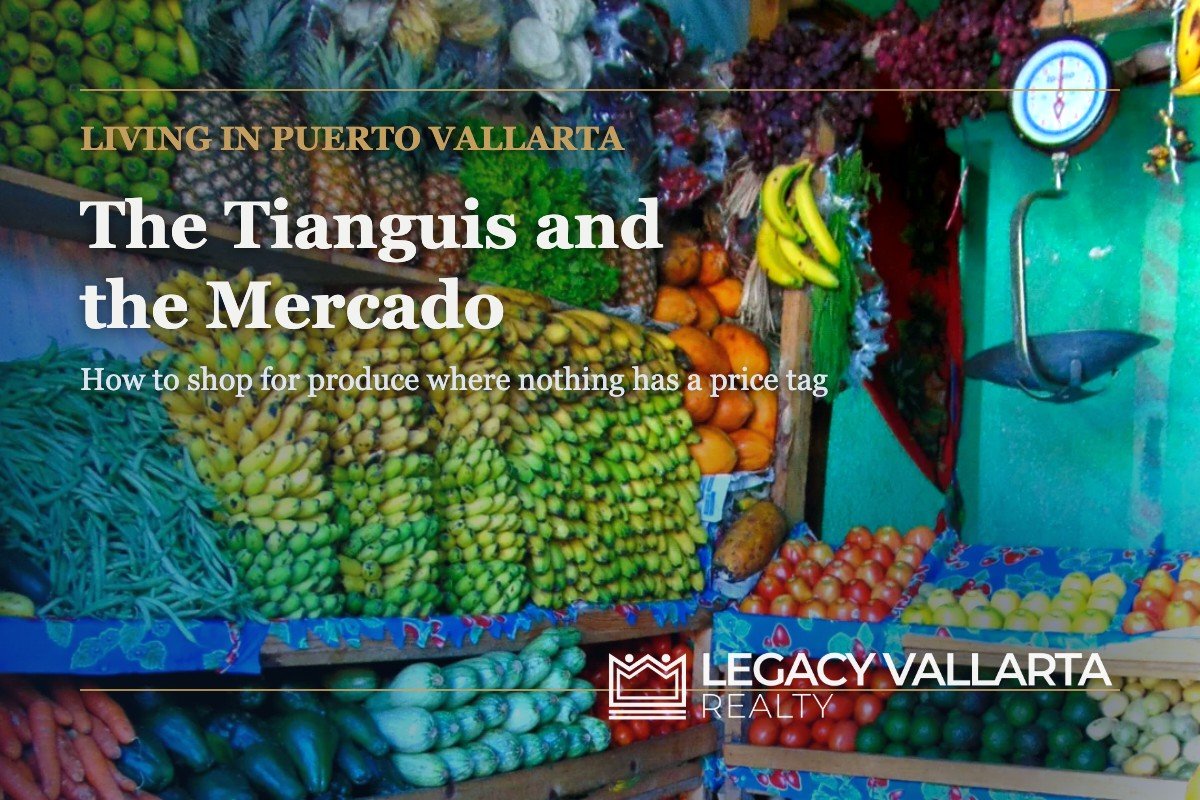
This is the part that paralyses people, and it should not. The absence of price tags does not mean the price is invented for you on the spot. Produce here is sold by the kilo, the vendor knows the price, and it is the same price for you as for the woman ahead of you in line.
What you do is simple. You say what you want and roughly how much: un kilo de jitomate, por favor. Or you point and say medio kilo. If you want to know the price first, ¿a cómo el kilo? is the exact phrase everyone uses. Nobody will think less of you for asking. Everyone asks.
- Bring cash in small bills. Breaking a 500 for a 40-peso purchase at 7 a.m. is a real inconvenience for the vendor.
- Bring your own bag. Most stalls have plastic, but bringing your own is normal here and appreciated.
- Buy the fruit for the next two days, not the next ten. Produce that has not been waxed and cold-chained for a week is better and it does not last as long. That is the trade.
- Do not haggle over produce. Haggling belongs at a crafts stall selling to tourists. At a produce stall it reads as saying the vendor is trying to cheat you, which they are not.
That last point is the one I most want foreigners to hear. Somewhere along the way people got told that bargaining is the authentic Mexican thing to do. Over a hammock on the beach, fine. Over two kilos of onions from a woman who has been at that stall since five in the morning, it is just rude, and she will remember.
What is actually in season in Banderas Bay
Shopping seasonally is most of the savings, and here the seasons do not match the ones you grew up with. Mango season runs roughly through the spring and early summer and the local Ataulfos in particular are worth planning meals around. Papaya, plátano, limón and aguacate are effectively year-round. The rainy summer months bring the greens and the corn; the winter months bring the strawberries down from the highlands.
The practical rule is easier than a calendar: whatever is stacked highest and cheapest is what is in season. Walk the aisle once before you buy anything. The pile that is spilling off the table at twenty pesos a kilo is the pile you should be cooking from this week. That single habit does more for a grocery budget than any coupon.
If you want to eat what the market is good at without cooking it yourself, the same produce shows up a few blocks away — Marisma Fish Taco in Centro and Birria El Tío Tono in Versalles are both places where you can taste what the ingredients here are capable of before you try to reproduce it.
Your marchante, and why you go back to the same stall
Here is the thing that no shopping guide explains, and it is the reason the mercado is not just a cheaper supermarket.
When you keep going back to the same vendor, you become their marchante. The word cuts both ways — you call them marchante and they call you marchante, and it means something closer to “the person I do business with” than to “customer.” It is a relationship, not a transaction, and it accumulates.
What that buys you is not a discount, exactly. It is that after a few months the vendor starts steering you. They tell you not to buy the papaya today because tomorrow’s is better. They put an extra chile or a couple of limes in the bag without mentioning it. They set aside the good avocados because they know you come on Thursdays. If you ask for something they do not have, they walk you to the stall that does — including a competitor, because the relationship outranks the single sale.
None of that is available to someone who shops at whichever stall is closest to where they parked. It is only available to someone who comes back. That is the whole mechanism, and it is why the answer to “which stall is best” is really “pick a decent one and stay.”
Where to Go From Here
This is the mechanism behind something we wrote about earlier: why the cost of living varies so much here. Two people in the same building genuinely can live on very different budgets, and the market is a large part of the difference.
If you are still deciding which neighbourhood to land in, where should I move in Puerto Vallarta covers the trade-offs — and proximity to a good mercado is a legitimate item on that list, not a small one.
This article is for general information only. Market days, hours and seasonal opening dates change; confirm current schedules locally before planning a trip.
📐 Full written guide: legacyvallartarealty.com
📅 Book a 30-minute call: meetings.hubspot.com/neft
💬 Or message me on WhatsApp: wa.me/523227797718
🏠 More guides on living in Puerto Vallarta: legacyvallartarealty.com/blog
Legacy Vallarta Realty — Puerto Vallarta, Jalisco.
— Neft Román, Legacy Vallarta Realty
Affiliate of AMPI Puerto Vallarta y Compostela




Join The Discussion